FivePD Ranks Explained: Cadet to Chief Progression
Nobody joins a FivePD server dreaming of staying a cadet. But on most servers that is exactly where players stall – not because they are bad officers, but because the path from cadet to corporal is a mystery even to the sergeants handing out promotions. This guide explains how FivePD rank systems actually work, what genuinely gets players promoted, and how server owners can build a ladder players respect.
One thing up front: FivePD itself does not force one universal rank system on every server. The mod provides the tools – departments, progression data, supervision structures – and each community builds its own ladder on top. That is why rank names and requirements differ from server to server, and why the principles below matter more than any single server’s ruleset.
How FivePD rank systems work
Under the hood, FivePD tracks things like played time, completed callouts, and officer records in its database. Servers then layer their own promotion logic on top, which almost always combines three ingredients:
- Time in service. Hours played as an officer, measured to filter out brand-new accounts.
- Activity quality. Callouts completed, reports filed, arrests made – with clean outcomes, not just raw numbers.
- Supervisor review. A real person (sergeant or higher) signs off on the promotion.
The servers with the healthiest rank cultures treat all three as required. Time-only ladders fill up with inactive veterans. Stats-only ladders get farmed. Review-only ladders depend on whether a supervisor likes you. Combined, they produce officers other players actually want on a scene.
The typical ladder: cadet to chief
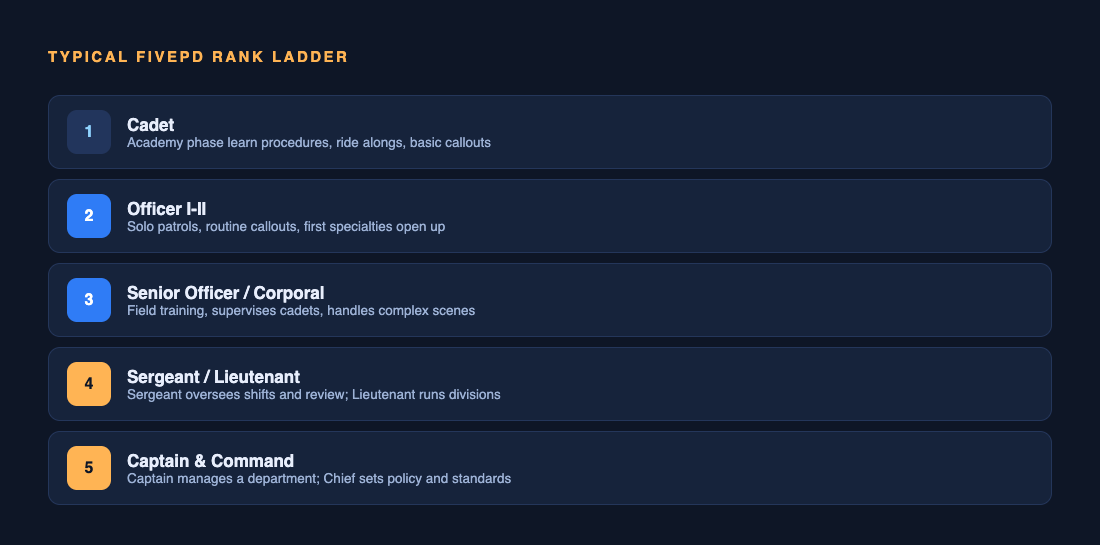
Most FivePD communities run some version of a five-tier ladder:
- Cadet. The academy phase. You learn procedures, ride along with senior officers, and practice basic callouts. Many servers gate vehicle access and solo patrol behind this rank deliberately.
- Officer I-II. The workhorse ranks. Solo patrols, routine callouts, and the first specialty applications open up. Most of a department’s activity lives here.
- Senior officer / corporal. The first leadership test: field training for cadets, supervising scenes, handling complex callouts. This is where servers decide whether you are material for command.
- Sergeant / lieutenant. Sergeants run shifts and review promotions; lieutenants typically run a division or a watch. These are staff positions – your job is now other officers’ performance.
- Captain and command. Department-level responsibility: policy, standards, discipline appeals, and the server’s overall RP culture. Chief is usually an admin-adjacent role rather than a gameplay rank.
What actually gets you promoted
Ask five supervisors what earns a promotion and you will hear the same five things:
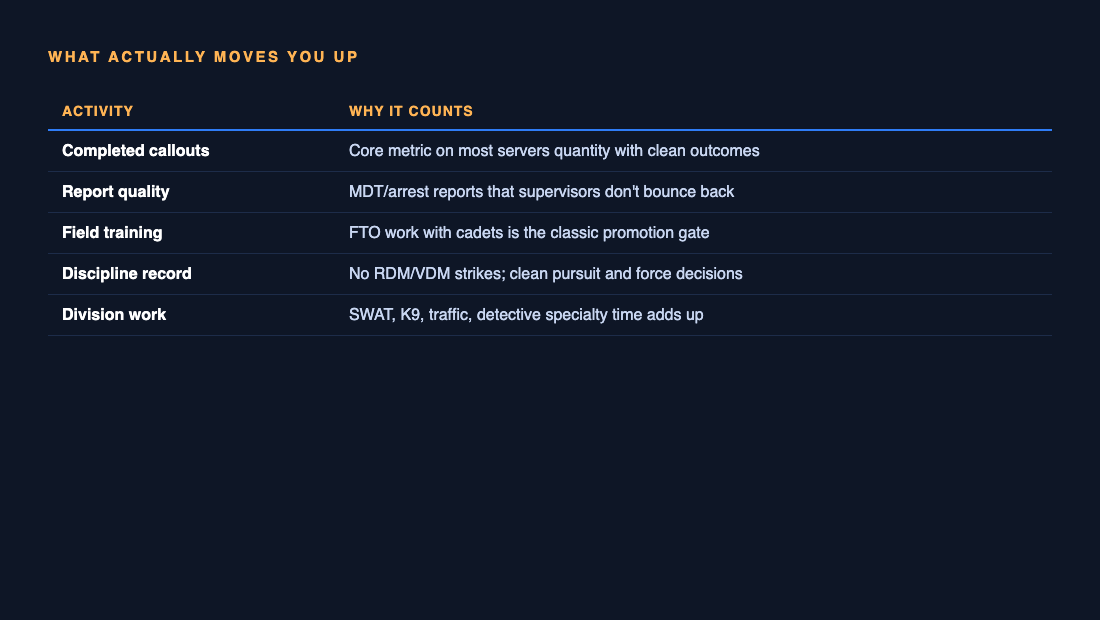
- Completed callouts with clean outcomes. Quantity matters, but a callout handled poorly counts against you on well-run servers. The pattern supervisors look for is consistent, correct scene management.
- Report quality. MDT and arrest reports that do not bounce back. Sloppy paperwork is the most common invisible promotion blocker.
- Field training work. FTO time with cadets is the classic gate between officer and senior ranks. It proves you can teach, not just perform.
- A clean discipline record. No RDM/VDM strikes, sensible force decisions, clean pursuits. One rage moment can cost you a promotion cycle.
- Division participation. SWAT, K9, traffic, detectives – specialty time signals commitment beyond basic patrol.
What almost never gets you promoted: asking for it. On good servers, asking actively delays the process.
Rank vs. division: two different tracks
Players conflate these constantly. Rank is seniority – how much responsibility the department trusts you with. A division is a specialty – what kind of police work you do. A corporal in SWAT outranks a senior officer in traffic on paper, but neither track replaces the other: you can be a career-ladder officer who never joins a division, or a specialist who stays mid-rank for a year because they love K9 work.
Servers that keep the tracks separate promote faster and lose fewer officers, because players always have a next goal even when the rank ladder is crowded.
For players: how to progress faster
- Paperwork is gameplay. Filing complete reports after every significant callout is the single highest-leverage habit. Supervisors read reports more often than they watch pursuits.
- Volunteer for FTO duty the moment you are eligible. It is the standard bridge to senior ranks.
- Learn one callout type deeply instead of ten shallowly – then be the officer others call for it.
- Stay in character under pressure. Rank reviews remember blowups longer than highlights.
- Ask for feedback, not promotions. “What should I improve to make corporal?” gets you a mentor. “When do I rank up?” gets you ignored.
For the roleplay side of standing out – character building, radio discipline, scene presence – our officer character guide and Ten Roleplay Tips to Make You a Better FivePD Officer go deep.
For server owners: build a ladder that holds up
If you run the server, your rank structure is your retention structure. Three rules that hold up in practice:
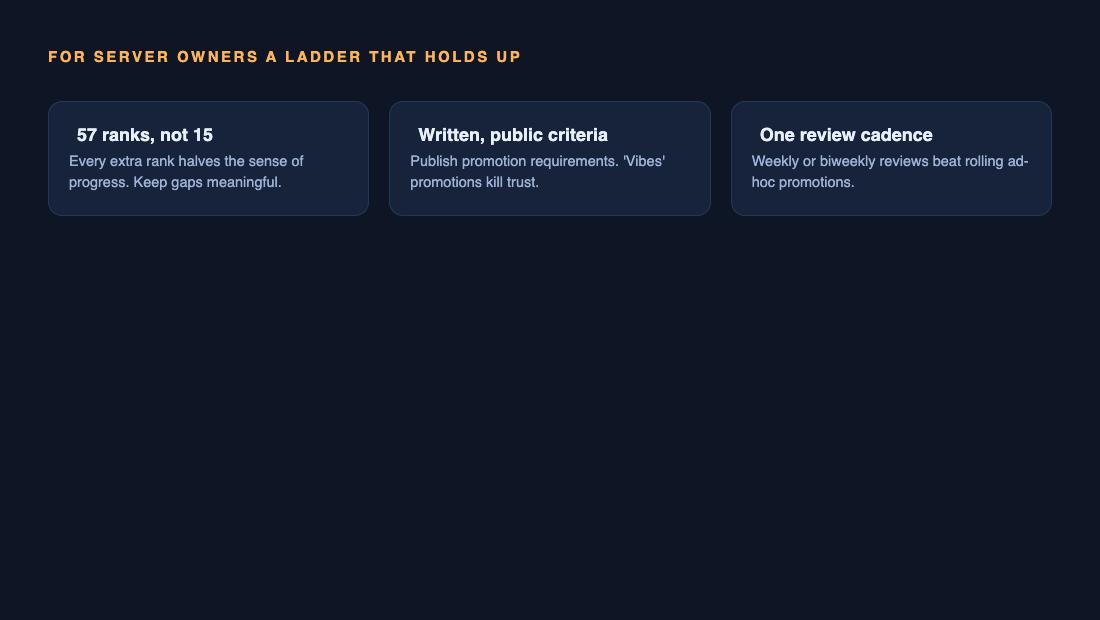
- Five to seven ranks, not fifteen. Every additional rank halves the sense of progress. Long ladders feel like treadmills; short ones feel like careers.
- Written, public criteria. Publish the promotion requirements per rank. “Vibes-based” promotions are the number-one cause of staff drama and officer churn.
- One review cadence. Weekly or biweekly promotion reviews beat rolling ad-hoc promotions, because they give every officer a predictable next checkpoint.
If you are still standing the server up, our FivePD server setup guide covers the technical half, and the optimization guide keeps it fast once players arrive.
FAQ
Do FivePD ranks carry over between servers?
No. Rank is stored per server in that server’s database. Moving communities means starting at cadet again – though experienced officers usually skip the queue via fast-track academy programs. Because every server publishes different requirements, check a community’s rank rules before you invest weeks in it – server review and rating sites like RPCrate make it easier to compare communities before you commit.
How long does it take to get promoted from cadet?
On most servers, a few days to two weeks of active patrolling for officer I – the cadet phase is deliberately short. Senior ranks typically take weeks to months, because field training and review cycles are the bottleneck by design.
What is an FTO in FivePD?
Field Training Officer – a senior-ranked player who trains cadets during ride-alongs. FTO duty is the most common requirement for promotion beyond senior officer, because it proves you can teach the department’s standards to new players.
Is chief an admin rank?
Usually, yes. Chief of police tends to overlap with server staff or community leadership, since it involves policy and discipline authority rather than just gameplay. Some large servers separate them – a gameplay chief who reports to an RP city council, for example.
Ready to put the theory to work? Learn what separates good departments in What Makes a Great FivePD Server?, or see how to join a FivePD server and start your cadet phase tonight.